

This is the version history of The MIRE. Releases are typically monthly.
New to The MIRE? Start with Welcome to The MIRE.

2026.11.3 – October 2026, just in time
The last point release in October. Promise. This one is about knowing who’s who.
- One key, one owner. Scanners that ask for the right files get a canary key of their own. Until now, latecomers who asked for something dull got a key that had already been handed to somebody else. So when a key turned up in AWS, “who took it” was a shortlist, not a name.
- The lobby key. Now a key stays with whoever it was cut for. Everyone else shares the lobby key: one an hour, for whoever’s around. A personal key names its collector. A lobby key narrows it down to an hour.
- Why bother? Because the ones collecting keys aren’t always the ones spending them. One crew collects, another spends, sometimes within a second of each other and on different continents. That’s not a coincidence. That’s a supply chain, and from November we can follow it link by link.
- Spring cleaning, in October. The folder MIRE runs from was cluttered with old copies of itself. GitHub has kept that history for months, so the copies are gone. The folder also belonged to the account MIRE runs as. It shouldn’t have, and now it doesn’t. Whatever MIRE writes lives elsewhere. Naturally, we should have done that in January.
- Same rules all month. The settings are fixed for November, and the field reports go monthly from now on. A month should compare with the next.
2026.12 will be on time. Ish.

2026.11.2 – October 2026, yes, still
Another point release. This one is less about lying to scanners and more about listening to them.
- Uploads, read but not believed. PHP2Shell (CVE-2026-109618 and 109619) and its still-unpatched cousin CVE-2026-115560 smuggle code through PHP’s upload-progress feature. Our sites run patched PHP with upload progress switched off. MIRE now writes down the shape of every upload it’s sent: the boundary, the parts, the field names, the headers, and what the bytes are made of. Never what they say.
- The tool signs its name. Since 22 October, something calling itself PHP2Shell/1.0.0 has measured our upload limits a dozen times on seven sites: 1 MB, then 8 MB, then 20 MB. The door stayed shut.
- Gzip in a trench coat. Every half hour or so, two uploads arrive from Amazon EC2. The label says form upload, the boundary looks like Firefox or Chrome, and the browser claims to be Chrome 144, then Chrome 145 three seconds later. Unpacked, it’s a React2Shell attempt (CVE-2025-55182), numbered fields and all, gzipped so firewalls can’t read it. MIRE now unpacks it in memory, up to 1 MB. Gzip bombs welcome. None of our sites run Next.js. Nice outfit, wrong party.
2026.12 will still be on time. Probably.

2026.11.1 – October 2026, still
A point release, days after 2026.11. We said 2026.12 would be on time. We never said nothing would come before it.
- Dumps worth stealing. Scanners asked for database dumps under 4’294 different names, and every single one got the same file. Now each site has its own, rebuilt every six hours: an HR system on half the sites, a door-access log or a hospital records system on the rest. Sizes run from a modest 300 KB to a chunky 18.5 MB, as real exports do. Nobody real is in them, of course.
- Quick to start, slow to finish. Half the old downloads (1’079 of 2’196) gave up during the delay before a single byte arrived. Now the first bytes go out within seconds and the rest trickles. Patience is rewarded. Eventually.
- A key in the settings table. Every dump carries a Tracebit AWS canary where an app keeps its settings, next to the Thinkst MySQL tripwire. Two ways to find out where a dump ended up.
- “Could you fetch that for me?” Scanners ask our sites to fetch the cloud’s internal metadata address on their behalf, about 1’000 times in three months. One address per site now plays along and hands over a server’s credentials. A canary, naturally.
- What they did with all of it: the field report follows in a few weeks.
2026.12 will still be on time. Probably.
2026.11 – November 2026
Yes, we know it’s still October. Four canaries were used overnight, and we couldn’t sit on ten days of new traps until November. So 2026.11 is out early. Impatient? Guilty.
- More bait where attackers actually look. Terraform state, Kubernetes and cloud tool configs, shell history, build scripts, front-end config bundles, AI-proxy and Bedrock configs, and the .bak copy someone forgot to delete. Fresh canaries go to the files whose keys really get used. All four overnight ones came from AI-proxy configs: 30 different canaries used so far.
- Every site tells one story. Each site’s decoys now belong to one made-up company, and its files agree with each other: the SSH key matches its public half, the cloud files match the canary, the Git remote has a login. Fewer loose threads for anyone checking.
- A Git repository worth dumping. Tools that download a whole .git folder get a complete, believable repository, with canaries where a careless developer would leave them.
- A login for every app. Sign-in, sign-up and password-reset pages for the sweeps that hunt for SaaS dashboards. Whatever they type, it’s wrong. Naturally.
- Attacks hiding in query strings. A static page ignores its query string, so payloads tacked onto real pages got a polite 200 and vanished. Now they land in The MIRE: about 9’400 since July, nearly three in four of them asking for a WordPress that doesn’t live here any more.
- Repeat offenders, noted. An address whose stolen key was used is flagged every time it comes back. For now we only watch. What they get next is still being decided.
- Fewer tells. Scanners test for honeypots by asking for pages that can’t exist. Those now get a plain “not found”, and a few other giveaways went too.
- Nothing forgotten. Logs rotate without losing the all-time numbers, and older logs move to a NAS that nothing on this server can delete.
- The story behind it: Don’t Stop Me Now. The canary field report is to follow.
- Field reports: Three Keys, Three Hands and I Just Can’t Get Enough.
2026.12 will be on time. Probably.

2026.10 – October 2026
- Live canary credentials. Some of the AWS keys, SSH keys, GitLab logins and session cookies The MIRE hands out are real Tracebit canaries that report any use. The long-lived kinds are shared over time, so the free quota is never exhausted, and the bait never breaks if Tracebit is unreachable.
- The first bite, five minutes after harvest, and an alert feed joined back to who took each key: The Keys That Bite Back.
- “Used” on the statistics page: canaries tried, by how many IPs, how soon after harvest, and what attackers went for.
- Deep tarpit for debug paths (/dev, /test, /staging): crawlers that walk the tree are held longer the deeper they go, and the tree now ends.
- Scanners no longer receive one fixed notice that could fingerprint The MIRE.
- This site’s welcome page, rewritten.

2026.09 – September 2026
- Route gaps closed: bare directories, .php/.html scanner variants, doubled WordPress API prefixes, version-control siblings and open-proxy probes.
- A maze for scrapers replaying lists of Chinese-titled URLs.
- Decoy archives without duplicate entries.
- A new neutral 404 page: “There is no spoon”.
- Field reports: Patterns, not doors and The Polite Redirect.
2026.08 – August 2026
- Wider crawler interception, and a per-IP decoy budget: past it, a client keeps the delay but gets lighter decoys.
- What 7’434 user-agents taught us.
2026.07 – July 2026
- The big update: new decoy routes, a tarpit for AI crawlers, and a move to gevent, so one worker holds thousands of slow connections.
- Faster decoy generation, video-on-demand decoy fixes and capture of submitted credentials.
- What 421’000 dead-ends taught us and ClaudeBot wasn’t alone.

2026.06 – June 2026
- The MIRE’s code moves into version control.
- How ClaudeBot fell in love with The MIRE/C³.
2026.03 – March 2026
2026.01 – January 2026
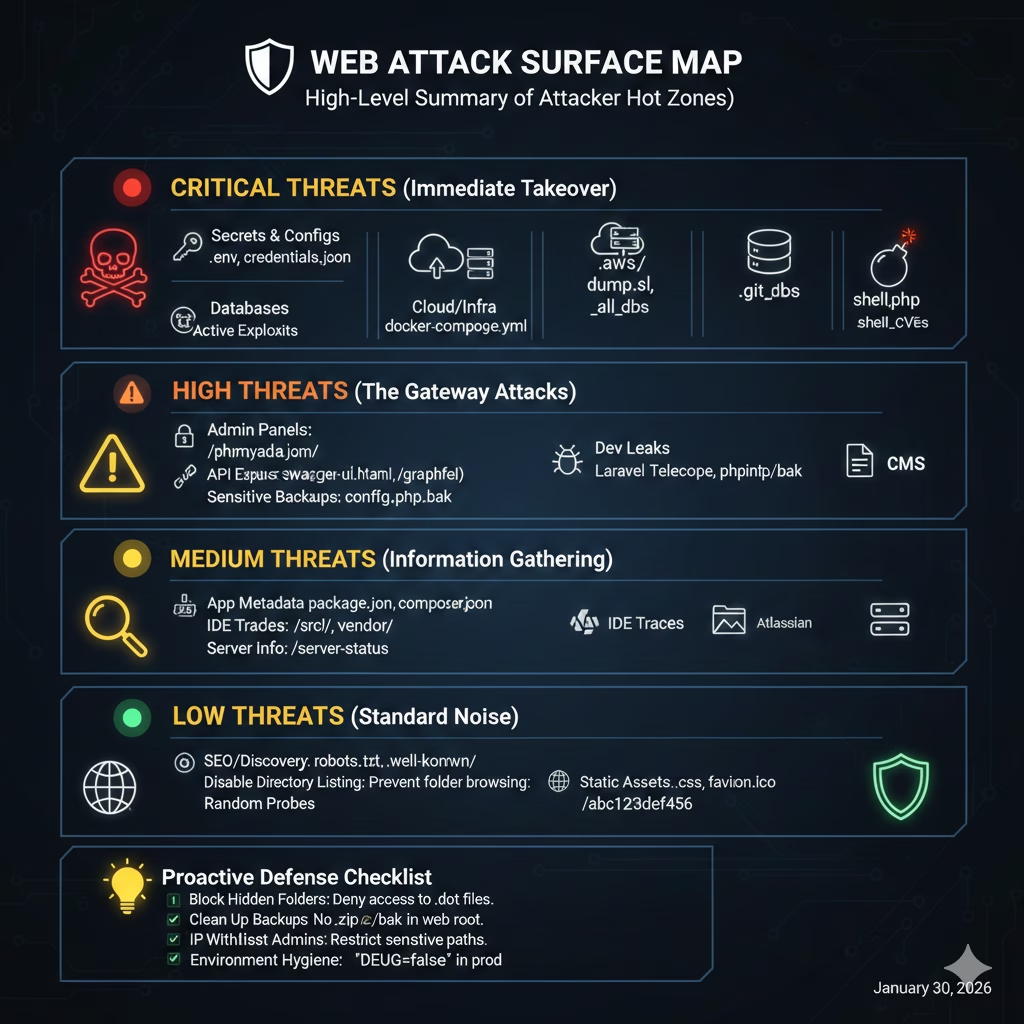
- Requests sorted into attack categories, with a page on the types of attacks.
- The statistics start counting.

2025.12 – December 2025
- The MIRE goes live: Welcome to The MIRE.
- First results: 333 Hours of Mire.